

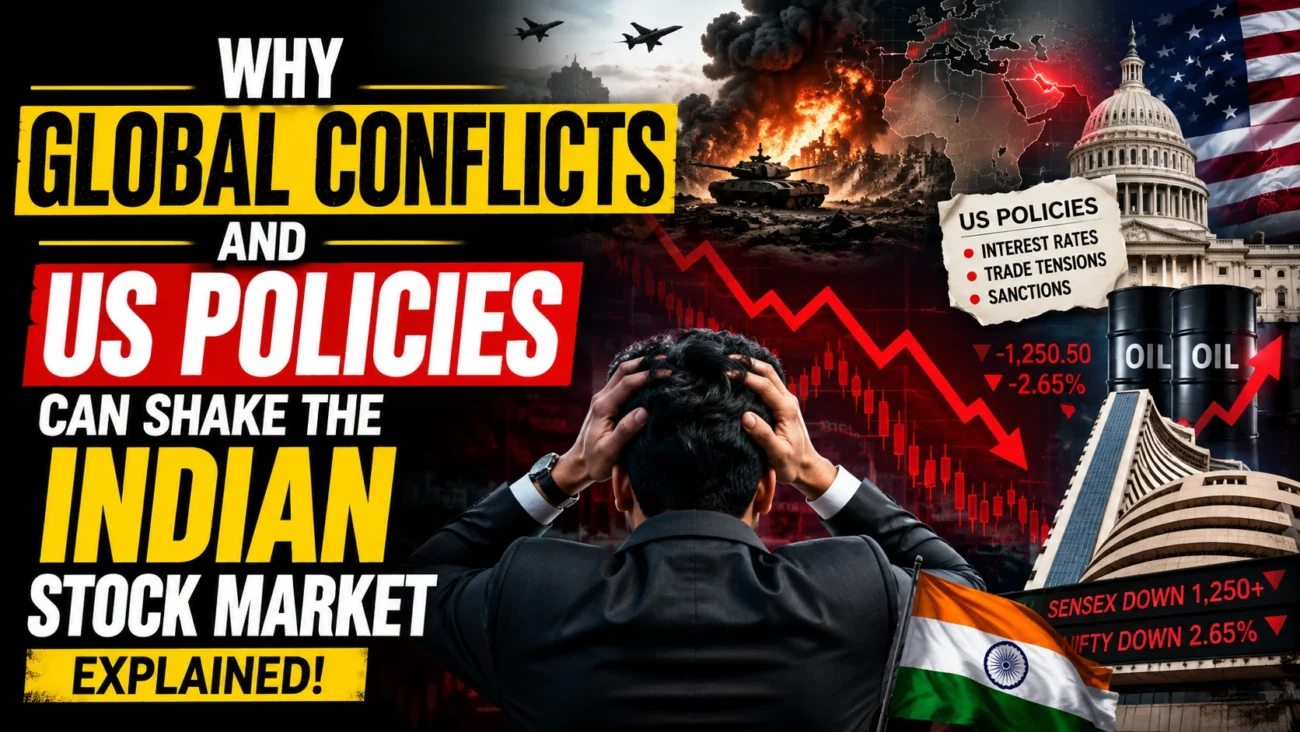
Why Global Conflicts and Indian Stock Market Are Deeply Connected
Global conflicts and Indian stock market movements are closely connected in today’s economy. A war in the Middle East, rising tensions between major countries, or sudden US policy decisions can instantly impact Sensex and Nifty.
Modern financial systems are interconnected through:
- Foreign investments
- Crude oil imports
- Currency exchange
- Global trade
- Inflation
- Interest rates
Whenever uncertainty increases globally, investors become fearful. That fear often creates sharp volatility in the Indian stock market.
Why Does the Indian Stock Market React to Global News?
Many investors get confused when the Indian stock market suddenly crashes because of events happening thousands of kilometers away. A war in the Middle East, a decision by the US President, rising oil prices, or tensions between global powers can instantly impact Indian markets.
This happens because modern financial markets are deeply interconnected. Foreign investors, global trade, crude oil imports, currency exchange rates, inflation, and interest rates are all linked together.
Whenever uncertainty rises globally, investors become fearful. Fear leads to selling pressure in stock markets, including India. That is why even if Indian companies are fundamentally strong, the Sensex and Nifty can still fall sharply during global crises.
Understanding how global events affect your investments is extremely important if you want to become a smart long-term investor.
What Happens During a Global Geopolitical Crisis?
Geopolitical crises include:
- Wars and military conflicts
- Trade wars
- Sanctions between countries
- Oil supply disruptions
- Political instability
- Terror attacks
- Diplomatic tensions
When such events happen, global investors usually move their money from risky assets like stocks into safer investments such as:
- Gold
- US Dollar
- Government bonds
- Safe-haven assets
As a result, stock markets around the world witness volatility and sudden corrections.
Why Is the Middle East Important for the Indian Economy?
One of the biggest reasons global tensions impact India is crude oil.
India imports a major portion of its crude oil requirements from Middle Eastern countries. If tensions rise in that region:
- Oil supply may get disrupted
- Crude oil prices may rise sharply
- Inflation can increase in India
- Rupee may weaken
- Fuel prices may rise
- Corporate profits may decline
This creates panic in the Indian stock market.
How Rising Crude Oil Prices Affect Indian Investors
1. Higher Inflation
When crude oil prices increase:
- Petrol and diesel become expensive
- Transportation costs rise
- Manufacturing costs increase
- Food prices may rise
This creates inflation across the economy.
Higher inflation reduces purchasing power and slows down consumption.
2. Pressure on RBI Interest Rates
To control inflation, the Reserve Bank of India may keep interest rates higher for longer.
Higher interest rates negatively affect:
- Real estate sector
- Auto sector
- Banking loans
- Consumer spending
As borrowing becomes expensive, economic growth may slow down.
3. Lower Corporate Profits
Companies face higher costs due to:
- Expensive raw materials
- Rising transportation costs
- Weak consumer demand
Lower profits often lead to lower stock prices.
Why Foreign Investors Pull Money Out During Global Uncertainty
Foreign Institutional Investors (FIIs) play a massive role in Indian markets.
During uncertain times, FIIs often:
- Sell Indian equities
- Shift money into US bonds
- Move funds into safer markets
This selling pressure can trigger major market corrections in India.
Even fundamentally strong stocks may fall because of panic selling.
Why the US Economy Influences the Indian Stock Market
The United States is the world’s largest economy.
Any major US decision related to:
- Interest rates
- Trade policies
- Foreign relations
- Sanctions
- Wars
- Oil production
can impact global markets instantly.
If the US Federal Reserve keeps interest rates high:
- Global liquidity reduces
- Investors avoid emerging markets
- FIIs withdraw money from India
This weakens Indian equities.
How Fear Impacts the Stock Market More Than Reality
One important thing investors must understand:
Markets react faster to fear than facts.
Sometimes markets crash even before actual economic damage happens.
Why?
Because investors hate uncertainty.
When headlines are filled with:
- War fears
- Oil supply concerns
- Economic slowdown predictions
- Political tensions
investors panic and start selling.
This emotional reaction creates sharp short-term volatility.
Which Sectors Are Most Affected During Global Crises?
1. Aviation Sector
Airline companies suffer because:
- Fuel costs rise
- Travel demand weakens
2. Paint and Chemical Companies
These industries depend heavily on crude oil derivatives.
Higher oil prices reduce profit margins.
3. Automobile Sector
Rising fuel prices and expensive loans reduce vehicle demand.
4. Banking and Financial Stocks
Higher uncertainty and weak economic growth increase risks in lending.
5. IT Sector
US economic slowdown fears can impact Indian IT companies because many depend on American clients.
Which Sectors May Benefit During Global Uncertainty?
1. Oil & Gas Companies
Some energy companies benefit from rising oil prices.
2. Defense Sector
Global conflicts can increase defense spending worldwide.
Defense-related businesses may gain attention.
3. Gold and Safe-Haven Assets
Gold is traditionally considered a safe investment during uncertainty.
That is why gold prices often rise during wars and crises.
Should Investors Panic During Market Crashes?
This is where most retail investors make mistakes.
Market crashes create fear, but long-term investors understand:
- Volatility is temporary
- Quality businesses survive
- Corrections create buying opportunities
Historically, markets recover after every major crisis:
- Global recessions
- Wars
- Pandemics
- Financial crashes
Investors who stay calm and continue investing systematically often build significant wealth over time.
Smart Strategies Investors Should Follow During Uncertain Times
1. Avoid Emotional Decisions
Do not sell quality investments purely because of fear.
Emotional investing destroys long-term wealth creation.
2. Maintain Emergency Funds
Always keep emergency savings for 6–12 months.
This prevents forced selling during market downturns.
3. Diversify Your Portfolio
Avoid putting all money into:
- One stock
- One sector
- One asset class
Diversification reduces risk.
4. Continue SIP Investments
Systematic Investment Plans (SIPs) help investors benefit from market corrections through rupee cost averaging.
Long-term SIP investing works well during volatile periods.
5. Focus on Strong Companies
Companies with:
- Low debt
- Strong cash flow
- Consistent profits
- Competitive advantages
usually recover faster after market corrections.
How Retail Investors Can Use Market Corrections Wisely
Instead of fearing market crashes, experienced investors often use them to:
- Accumulate quality stocks
- Increase SIP contributions
- Invest at lower valuations
Temporary panic can create long-term opportunities.
However, blindly buying every dip is not wise. Investors should focus on fundamentally strong businesses.
Why Long-Term Thinking Matters More Than Daily News
One of the biggest mistakes investors make is reacting to every headline.
Daily market news creates noise:
- Political statements
- Global tensions
- Economic fears
- Social media panic
But wealth creation happens through:
- Patience
- Discipline
- Long-term investing
- Asset allocation
- Consistency
Short-term volatility is normal in equity investing.
Important Lessons Every Investor Should Learn
Global events will always create uncertainty.
There will always be:
- Wars
- Political tensions
- Economic fears
- Oil price shocks
- Market corrections
But disciplined investors focus on:
- Financial planning
- Long-term goals
- Diversification
- Risk management
rather than temporary panic.
The stock market rewards patience more than prediction.
Conclusion : Global Conflicts and Indian Stock Market
Global conflicts, US policies, oil prices, and geopolitical tensions can strongly affect the Indian stock market because modern economies are interconnected.
However, temporary market crashes do not necessarily mean long-term wealth destruction. Investors who understand market cycles, remain calm during volatility, and continue investing wisely often emerge stronger over time.
Instead of reacting emotionally to headlines, focus on:
- Building strong financial habits
- Maintaining diversification
- Investing consistently
- Thinking long term
Market uncertainty is unavoidable, but financial discipline can help investors survive and grow through every cycle.
FAQs on Global Conflicts and Indian Stock Market
Why does the Indian stock market fall because of global wars?
Global wars increase uncertainty, raise crude oil prices, and trigger foreign investor selling, which negatively impacts Indian markets.
How do rising crude oil prices affect India?
India imports large amounts of crude oil. Rising prices increase inflation, fuel costs, transportation expenses, and pressure corporate profits.
Should I stop SIPs during market crashes?
Long-term investors generally continue SIPs during corrections because lower prices help accumulate more units through rupee cost averaging.
Which sectors suffer most during geopolitical tensions?
Aviation, automobile, chemicals, paints, and banking sectors are usually affected due to rising costs and weaker economic activity.
Is gold a good investment during global uncertainty?
Gold is often considered a safe-haven asset and tends to perform better during geopolitical tensions and market volatility.
Can stock markets recover after global crises?
Historically, stock markets have recovered after wars, recessions, pandemics, and economic crises. Long-term investing and patience are important.
About The Author

