

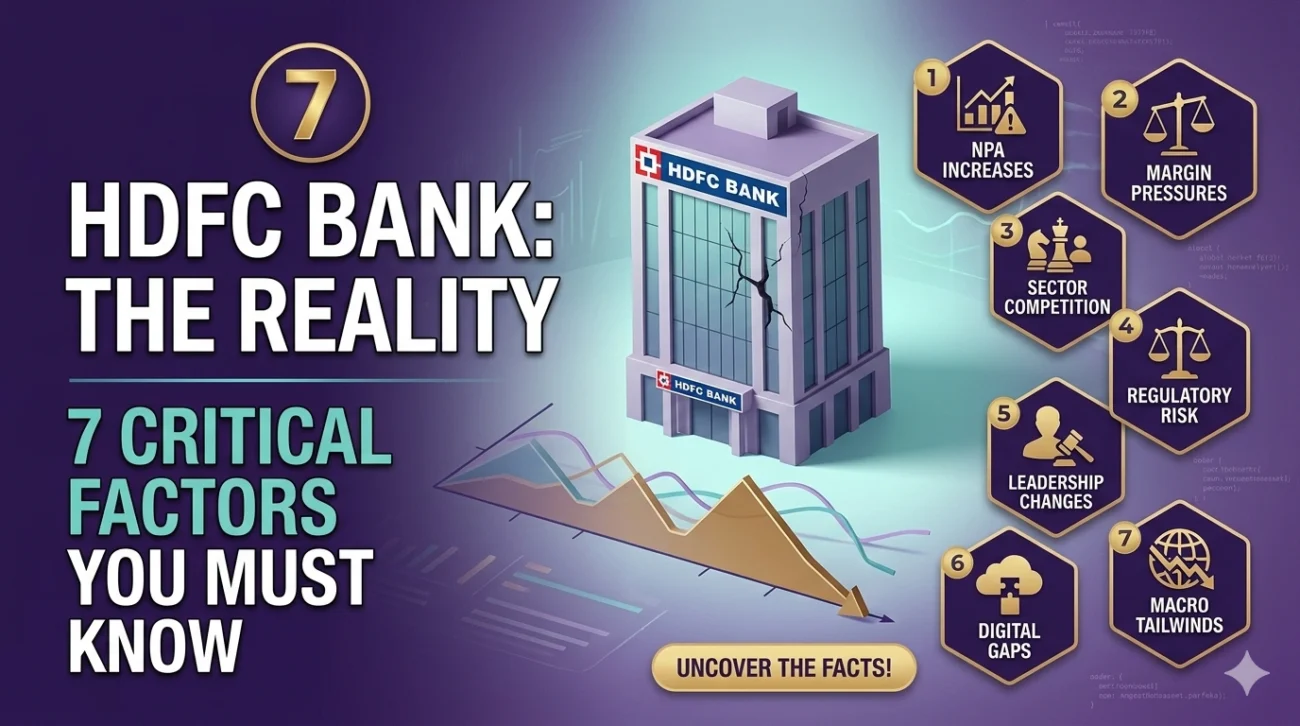
HDFC Bank growth slowdown 2025 is becoming one of the most discussed topics among Indian investors. Once known for consistent performance, the bank is now facing temporary pressure due to merger impact, deposit challenges, and structural adjustments.
Why HDFC Bank Growth Slowdown 2025 Is in Focus
For years, HDFC Bank has been considered one of the most reliable and consistent wealth creators in India. Known for strong management, stable growth, and high asset quality, it has been a favorite among retail and institutional investors alike.
However, recently, many investors have started asking:
- Why is HDFC Bank share price underperforming?
- Has growth slowed down after the merger?
- Should long-term investors be worried?
The reality is not black and white. To understand what’s happening, we need to look deeper into numbers, strategy, and structural changes within the bank.
HDFC Bank Growth Slowdown 2025 After Merger Impact
The biggest turning point for HDFC Bank was its merger with Housing Development Finance Corporation (HDFC Ltd). While this merger created a financial giant, it also introduced short-term challenges.
Key Effects of the Merger
- Massive increase in loan book (especially home loans)
- Sudden spike in loan-to-deposit ratio (LDR)
- Pressure on liquidity and deposit growth
- Temporary slowdown in profitability
This merger is strategically positive long-term, but in the short term, it has created imbalance in the bank’s financial structure.
Loan-to-Deposit Ratio and HDFC Bank Growth Slowdown 2025
One of the biggest concerns right now is HDFC Bank’s Loan-to-Deposit Ratio (LDR).
👉 LDR = Loans Given / Deposits Collected
| Metric | Ideal Range | Current Concern |
|---|---|---|
| Loan-to-Deposit Ratio | 80% – 90% | Higher than comfort level |
| Deposit Growth | Strong expected | Currently lagging |
| Loan Growth | Very high post-merger | Creating pressure |
When LDR becomes too high:
- Banks may struggle to lend further
- Liquidity risk increases
- Profitability may get impacted
This is exactly what HDFC Bank is dealing with right now.
Deposit Growth Issues Behind HDFC Bank Growth Slowdown 2025
In India, banks grow primarily by increasing deposits. But currently:
- Competition for deposits has increased (SBI, ICICI, small finance banks)
- Investors are moving towards mutual funds and equities
- Interest rates dynamics are shifting
For HDFC Bank, this means:
- Slower deposit growth
- Higher cost of funds
- Pressure on margins
This is one of the key reasons behind the temporary slowdown in performance.
Profitability Pressure in HDFC Bank Growth Slowdown 2025
Another important factor is Net Interest Margin (NIM).
After the merger:
- Cost of funds has increased
- Loan mix has changed (more home loans = lower yield)
- Integration costs have risen
All these factors together reduce short-term profitability.
However, this does not necessarily mean the business is weak — it reflects a transition phase.
Risks in HDFC Bank Growth Slowdown 2025 Investors Must Know
Many investors judge companies only by stock price movement. But in the case of HDFC Bank:
- Stock may be sideways or slow-moving
- But underlying business is still strong
Key Strengths Still Intact
- Strong brand trust in India
- High-quality loan book
- Low NPAs (Non-Performing Assets)
- Experienced management
- Long-term growth potential
This is why many long-term investors still consider it a core portfolio stock.
Short-Term vs Long-Term Outlook: Clear Comparison
| Factor | Short-Term View | Long-Term View |
|---|---|---|
| Growth | Slower due to merger | Strong recovery expected |
| Profitability | Slight pressure | Stable & improving |
| Deposits | Catching up | Strong expansion likely |
| Stock Movement | Sideways/volatile | Potential long-term compounding |
| Risk | Moderate | Lower over time |
Key Risks Investors Should Not Ignore
Even though HDFC Bank remains strong, investors should be aware of risks:
- Delay in deposit growth recovery
- Rising competition from fintech & private banks
- Interest rate fluctuations
- Integration challenges post-merger
Understanding risks helps you make informed investment decisions rather than emotional ones.
Investment Strategy During HDFC Bank Growth Slowdown 2025
1. Avoid Panic Selling
Short-term noise should not affect long-term conviction.
2. Focus on Fundamentals
Look at business quality, not just stock price movement.
3. Use SIP or Staggered Investing
Instead of lump sum, invest gradually to reduce risk.
4. Diversify Your Portfolio
Don’t rely only on one stock — balance with mutual funds, ETFs, and other sectors.
5. Track Key Metrics
Keep an eye on:
- Deposit growth
- LDR improvement
- NIM trends
Why HDFC Bank Can Still Be a Long-Term Wealth Creator
Despite current concerns, HDFC Bank still has:
- Strong retail loan franchise
- Leadership in private banking space
- Deep penetration across India
- Ability to adapt and scale
Historically, great companies go through temporary slowdowns before the next growth phase. This could be one such phase.
Final Verdict: Is HDFC Bank Still a Good Investment?
HDFC Bank is not a broken story — it’s an evolving one.
The merger has created short-term challenges, but it also sets the stage for long-term dominance in the Indian banking sector.
For investors who understand patience and fundamentals, this phase may not be a risk — it may be an opportunity.
FAQs
Q1. Why is HDFC Bank stock not performing in 2025?
The main reason is the merger impact, high loan-to-deposit ratio, and slower deposit growth affecting short-term performance.
Q2. Is HDFC Bank facing financial problems?
No, the bank remains fundamentally strong. The current slowdown is due to structural adjustments post-merger.
Q3. What is Loan-to-Deposit Ratio (LDR) in banking?
It measures how much a bank lends compared to deposits. A very high ratio indicates liquidity pressure.
Q4. Should I invest in HDFC Bank now?
Long-term investors can consider gradual investing, but should monitor key metrics like deposit growth and margins.
Q5. Is HDFC Bank safe for long-term investment?
Yes, historically it has been a strong performer with stable management and consistent growth over time.
About The Author

