

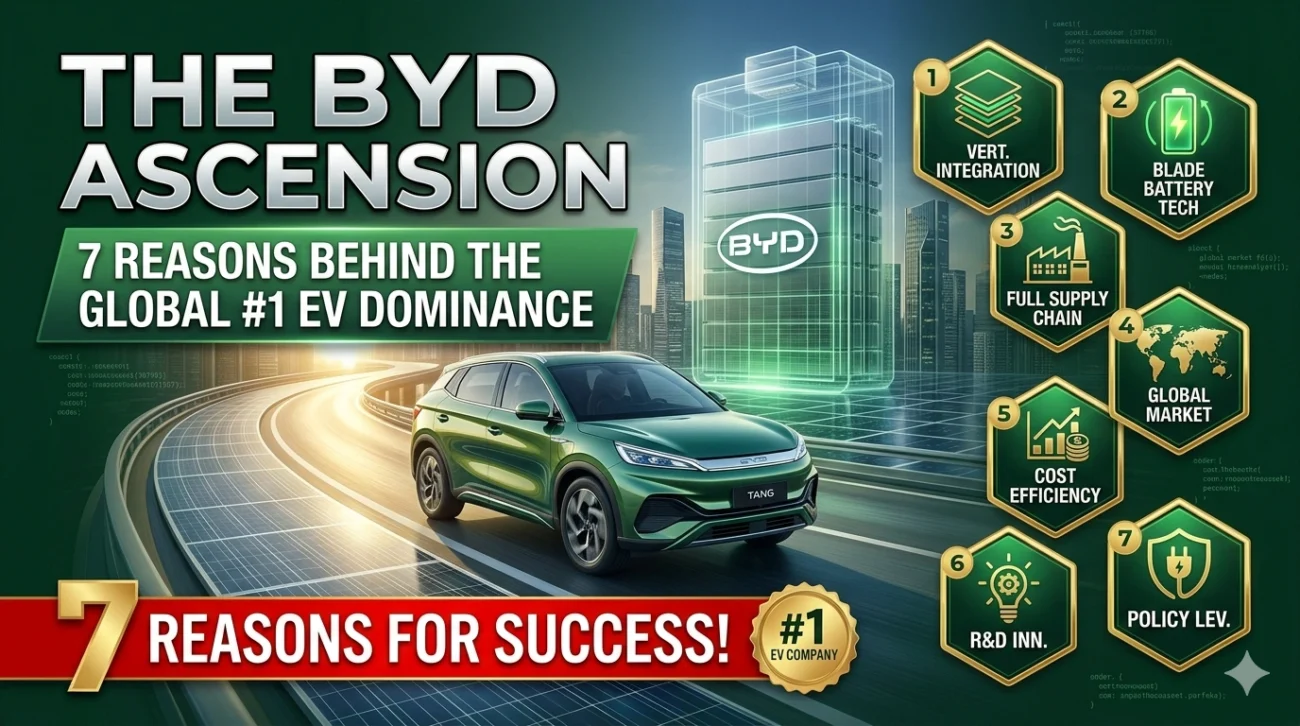
BYD EV strategy is the key reason behind its rise as the world’s leading electric vehicle company.
BYD EV strategy is the driving force behind its rise as the world’s leading electric vehicle company in 2026. While Tesla once dominated headlines, BYD has quietly built a powerful ecosystem through vertical integration, aggressive pricing, and government-backed expansion. Today, the BYD EV strategy is not just competing—it is reshaping the global EV market.
Why BYD EV Strategy Is Dominating the Global EV Market in 2026
The global electric vehicle (EV) industry is evolving at lightning speed, and one company has quietly risen to the top — BYD.
While many people associate EV innovation with Tesla, BYD has surpassed expectations by becoming one of the largest EV manufacturers in the world by sales volume.
From humble beginnings as a battery manufacturer to becoming a global EV powerhouse, BYD’s journey is a masterclass in strategy, execution, and long-term vision.
The Origin Story: From Batteries to a Global EV Powerhouse – BYD EV Strategy
BYD was founded in 1995 as a battery manufacturing company. Instead of jumping directly into automobiles, the company focused on mastering battery technology, which later became its biggest competitive advantage.
This early decision helped BYD control the most critical component of electric vehicles — the battery, reducing dependency on suppliers and lowering production costs.
The Core BYD EV Strategy Behind Its Global Success
Vertical Integration – The Backbone of BYD EV Strategy
One of BYD’s biggest strengths is its vertical integration strategy. Unlike many competitors, BYD manufactures almost everything in-house:
- Batteries
- Semiconductors
- Electric motors
- Vehicle components
This gives BYD:
- Lower production costs
- Better quality control
- Faster innovation cycles
While companies like Tesla rely on external suppliers for some components, BYD’s self-reliant ecosystem gives it a massive edge.
How China’s Government Policies Accelerated BYD’s Growth – BYD EV Strategy
The rise of BYD is closely tied to China’s aggressive push toward electric mobility.
Government support included:
- Subsidies for EV buyers
- Incentives for manufacturers
- Infrastructure investments (charging stations)
- Strict emission regulations
This created a perfect environment for BYD to scale rapidly and dominate the domestic market before expanding globally.
BYD vs Tesla: A Strategic Comparison of Two EV Giants – BYD EV Strategy
| Factor | BYD | Tesla |
|---|---|---|
| Core Strength | Battery manufacturing | Software & brand |
| Business Model | Vertical integration | Partial outsourcing |
| Market Focus | Mass market + affordability | Premium segment |
| Pricing Strategy | Competitive & accessible | Higher pricing |
| Global Expansion | Rapid (Asia, Europe, Latin America) | Strong in US & Europe |
👉 Insight:
BYD wins on scale and affordability, while Tesla dominates branding and innovation perception.
The Pricing Strategy That Made EVs Affordable for Millions – BYD EV Strategy
Unlike competitors focusing only on premium EVs, BYD targeted the mass market.
Key moves:
- Affordable EV models
- Wide product range (cars, buses, trucks)
- Cost leadership through vertical integration
This allowed BYD to capture huge market share, especially in developing countries.
Battery Innovation: The Secret Weapon Behind BYD’s Growth – BYD EV Strategy
BYD’s Blade Battery technology is one of its biggest breakthroughs.
Benefits include:
- Higher safety standards
- Longer lifespan
- Lower cost compared to traditional lithium-ion batteries
This innovation positioned BYD as not just a car manufacturer, but a battery technology leader.
Global Expansion Strategy: How BYD Is Conquering International Markets – BYD EV Strategy
After dominating China, BYD expanded aggressively into:
- Europe
- Southeast Asia
- Latin America
- Middle East
Instead of entering markets blindly, BYD focuses on:
- Local partnerships
- Government collaboration
- Competitive pricing
This strategic expansion is helping BYD become a truly global EV brand.
The Role of Scale: Why BYD’s Production Power Matters – BYD EV Strategy
BYD produces EVs at massive scale, which results in:
- Lower per-unit cost
- Higher margins
- Faster market penetration
Scale is one of the biggest reasons BYD can undercut competitors on price while maintaining profitability.
Challenges and Risks Facing BYD in the Global EV Race
Despite its success, BYD faces several challenges:
- Increasing competition from global automakers
- Trade restrictions in Western markets
- Dependence on Chinese supply chains
- Brand perception outside China
To sustain growth, BYD must strengthen its global brand and innovation edge.
Key Business Lessons from BYD’s Success Story
1. Control Your Core Technology
Owning critical components like batteries can create a massive competitive advantage.
2. Focus on Cost Leadership
Affordable pricing opens larger markets and drives scale.
3. Leverage Government Policies
Smart alignment with national policies can accelerate growth.
4. Scale Aggressively
Large-scale production reduces costs and increases market dominance.
5. Think Long-Term
BYD’s success didn’t happen overnight — it was built over decades.
What Entrepreneurs and Investors Can Learn from BYD
BYD’s journey is not just about EVs — it’s about strategic execution.
Entrepreneurs can learn:
- Build strong fundamentals before scaling
- Invest in core capabilities
- Focus on long-term sustainability
Investors can learn:
- Look beyond hype
- Identify companies with strong cost advantage
- Focus on industries with government backing
Conclusion: Why BYD Is the Future of the Electric Vehicle Industry
BYD’s rise is a perfect example of how strategy, innovation, and execution can transform a company into a global leader.
While Tesla may have popularized EVs, BYD is making them accessible to the world.
As the global shift toward electric mobility accelerates, BYD is not just participating — it is leading the revolution.
FAQs About BYD and the EV Industry – BYD EV Strategy
Q1. Is BYD bigger than Tesla?
BYD has surpassed Tesla in terms of total EV sales volume, especially when including hybrid vehicles.
Q2. What makes BYD different from other EV companies?
Its vertical integration, battery technology, and affordable pricing strategy set it apart.
Q3. What is BYD’s Blade Battery?
It is an advanced battery technology that offers better safety, durability, and cost efficiency.
Q4. Why is BYD successful in China?
Strong government support, infrastructure, and early market entry helped BYD dominate.
Q5. Is BYD expanding globally?
Yes, BYD is rapidly expanding into Europe, Asia, and other international markets.
About The Author

