

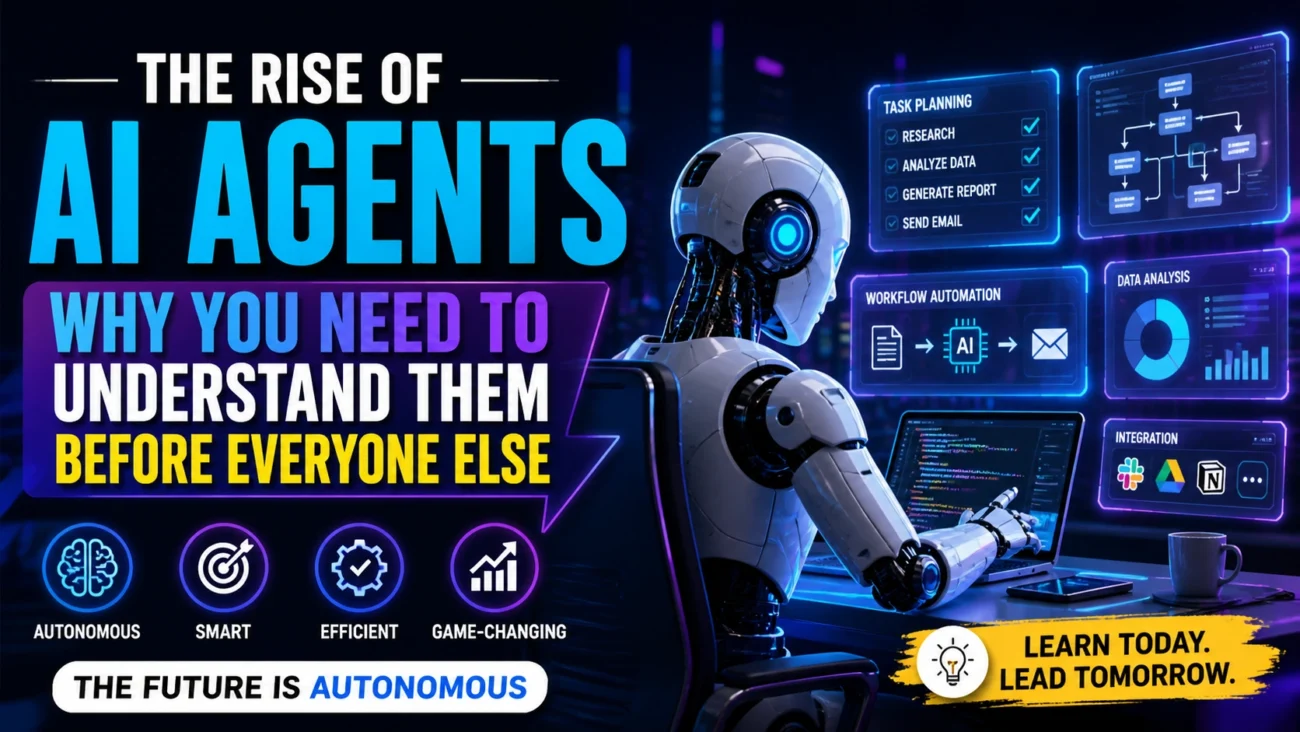
AI agents are rapidly transforming how we work, automate tasks, and build businesses. Unlike traditional tools, AI agents can think, plan, and execute tasks independently, making them one of the most powerful innovations in artificial intelligence today.
If you want to stay ahead in the digital era, understanding AI agents is no longer optional—it’s essential.
What Are AI Agents and Why Are They Gaining So Much Attention?
Artificial Intelligence has evolved rapidly over the last few years. From simple chatbots to highly advanced language models, the journey has been nothing short of revolutionary. But now, a new evolution is taking center stage — AI agents.
An AI agent is not just a tool that responds to prompts. It is a system that can think, plan, take actions, and complete tasks autonomously. Unlike traditional AI models that require continuous human input, AI agents can operate independently, making them incredibly powerful.
The buzz around AI agents is growing because they promise to replace repetitive human work, automate workflows, and even make decisions. This shift is similar to how the internet changed communication — AI agents are set to redefine productivity.
How AI Agents Are Different from Traditional AI Tools
Most people are familiar with AI tools that generate content, answer questions, or assist with coding. However, AI agents go far beyond that.
Traditional AI:
- Requires constant prompts
- Works task-by-task
- Limited autonomy
AI Agents:
- Can break down complex goals into smaller tasks
- Execute multi-step workflows
- Learn and improve from interactions
- Operate with minimal supervision
For example, instead of asking an AI to “write an email,” an AI agent can:
- Understand the context
- Gather required information
- Draft the email
- Send it automatically
This level of autonomy is what makes AI agents a game-changer in the tech world.
Why AI Agents Are the Future of Work and Productivity
The biggest reason AI agents are gaining traction is their ability to save time and increase efficiency.
Here’s how they are transforming different industries:
1. Business Automation
AI agents can handle customer support, lead generation, and sales follow-ups without human intervention.
2. Content Creation
They can research, write, edit, and even publish content automatically, reducing hours of manual work.
3. Software Development
Developers can use AI agents to debug code, build features, and test applications.
4. Personal Productivity
From managing calendars to planning finances, AI agents act like digital assistants that actually take action.
This shift is leading towards a future where humans focus on strategy while AI handles execution.
What Makes Modern AI Agents So Powerful?
AI agents are powered by a combination of advanced technologies:
- Large Language Models (LLMs): Enable understanding and generation of human-like text
- Memory Systems: Allow agents to remember past interactions
- Tool Integration: Connect with APIs, apps, and external tools
- Planning Algorithms: Break down tasks into actionable steps
Together, these components enable AI agents to function like independent digital workers.
7 Powerful Benefits of Learning AI Agents Early
If you’re wondering why you should care about AI agents right now, here are some strong reasons:
1. First-Mover Advantage
Early adopters gain a significant edge in understanding and applying new technology.
2. Career Opportunities
AI skills are among the most in-demand globally. Learning AI agents can open doors in tech, marketing, and business.
3. Business Growth
Entrepreneurs can automate operations and scale faster using AI agents.
4. Increased Productivity
AI agents can save hours of manual work every day.
In simple terms, learning AI agents today can future-proof your career and business.
Step-by-Step Guide to Getting Started
Step 1: Understand the Basics of AI and Automation
Before diving into AI agents, build a strong foundation in AI concepts and automation workflows.
Step 2: Learn Prompt Engineering
Even though AI agents are autonomous, understanding how to guide them effectively is crucial.
Step 3: Explore AI Agent Frameworks
There are multiple frameworks and platforms that allow you to build AI agents without deep coding knowledge.
Step 4: Start Building Simple Use Cases
Begin with small projects like:
- Automating email responses
- Creating content pipelines
- Managing simple workflows
Step 5: Scale to Complex Systems
Once comfortable, build advanced agents that can:
- Handle multi-step tasks
- Integrate with APIs
- Automate business processes
Real-World Use Cases
- E-commerce: Automating product descriptions and customer queries
- Finance: Managing budgets and tracking expenses
- Marketing: Running campaigns and analyzing performance
- Education: Personalized learning assistants
These use cases highlight how AI agents are not just theoretical — they are actively reshaping industries.
Challenges and Risks
- Over-reliance on automation
- Data privacy concerns
- Errors in decision-making
- Lack of human judgment in critical tasks
It’s important to use AI responsibly and always maintain a level of human oversight.
How to Stay Ahead in the AI Revolution
To truly benefit from AI agents, you need to stay proactive:
- Keep learning about new AI tools
- Experiment with real-world applications
- Follow industry trends
- Continuously upgrade your skills
The pace of AI innovation is rapid, and those who adapt early will have a significant advantage.
The Future: What to Expect
In the coming years, AI agents are expected to:
- Become more autonomous and intelligent
- Integrate deeply with everyday tools
- Replace repetitive jobs
- Create new industries and opportunities
We are at the beginning of a massive technological shift, similar to the early days of the internet.
Conclusion
AI agents are not just another tech trend — they represent the next phase of artificial intelligence. Those who understand and adopt this technology early will gain a massive advantage in their careers and businesses.
The question is no longer whether AI agents will change the world — it’s how prepared you are for that change.
Start learning, experimenting, and building today. Because in the world of AI, early movers win.
FAQs
Q1. What is an AI agent in simple terms?
An AI agent is a system that can think, plan, and perform tasks independently without constant human input.
Q2. How are AI agents different from ChatGPT-like tools?
AI agents can execute multi-step tasks and take actions, while traditional AI tools mainly respond to prompts.
Q3. Do I need coding skills to build AI agents?
Not necessarily. Many platforms allow you to create AI agents with little to no coding knowledge.
Q4. Are they safe to use?
They are safe if used responsibly, but human supervision is important to avoid errors or misuse.
Q5. Can they replace jobs?
They may replace repetitive tasks but will also create new job opportunities requiring advanced skills.
About The Author

