

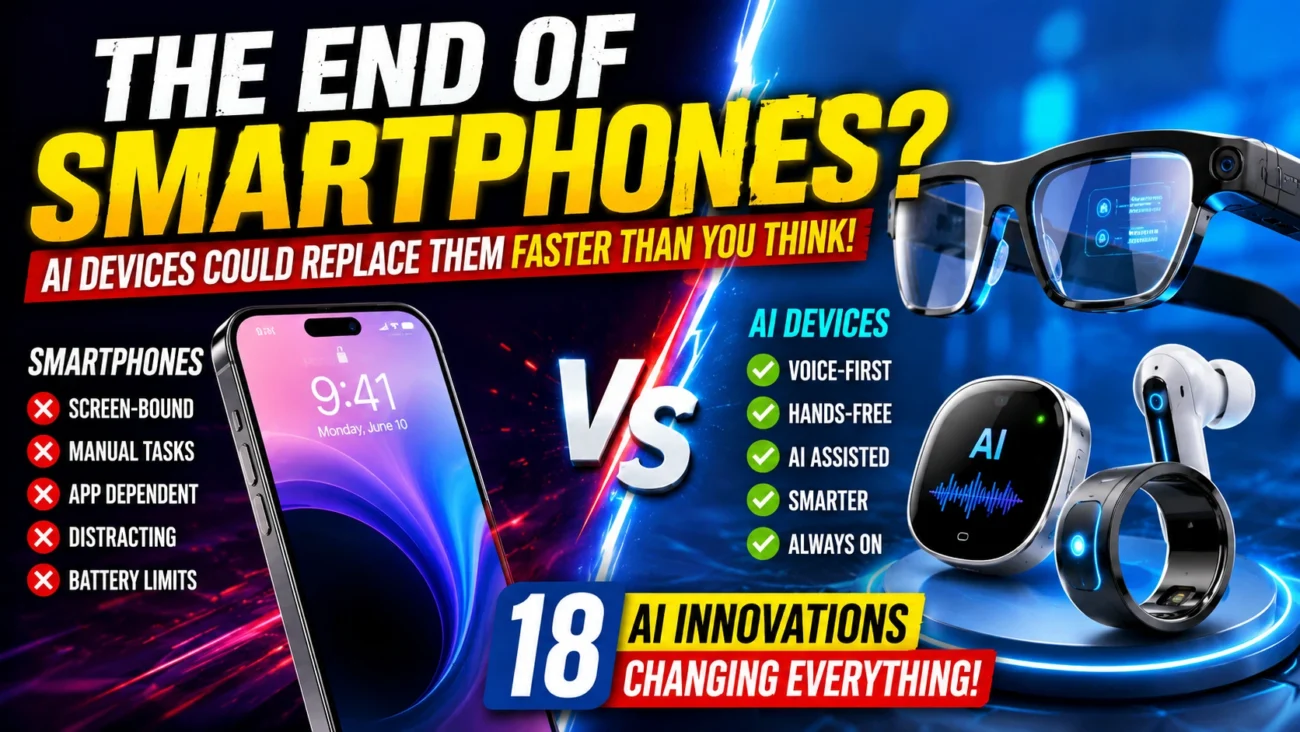
AI devices replacing smartphones could become the biggest technological disruption of this decade. As Artificial Intelligence evolves rapidly, experts believe traditional mobile phones may slowly lose importance to AI-powered wearables, voice assistants, smart glasses, and ambient computing systems.
Introduction: Is the Smartphone Era Coming to an End : AI Devices Replacing Smartphones?
For nearly two decades, smartphones have dominated our lives. From communication and entertainment to banking and shopping, everything revolves around a screen that fits in our pocket. But the technology world may now be approaching a massive shift — one that could redefine how humans interact with devices forever.
Artificial Intelligence is no longer just a software feature. It is becoming the foundation of an entirely new computing era. With rapid developments in generative AI, AI assistants, voice-first computing, wearable devices, and personalized digital agents, experts believe smartphones may slowly lose their importance in the coming years.
The biggest tech companies in the world are racing toward an AI-first future. Instead of tapping screens all day, users may soon interact naturally with AI through voice, smart glasses, wearable devices, ambient computing systems, and real-time assistants that understand human behavior better than ever before.
This technological transition could become one of the largest disruptions since the launch of the iPhone in 2007.
Why AI Devices Replacing Smartphones Is Becoming Reality
The smartphone market has already started showing signs of maturity. Innovation has slowed significantly over the last few years.
Most modern smartphones now offer:
- Better cameras
- Slightly faster processors
- Improved battery life
- Incremental software updates
But consumers are no longer excited by small hardware upgrades. People keep their phones longer than before because the difference between a new and old smartphone is becoming smaller.
At the same time, Artificial Intelligence is creating a completely new user experience.
Instead of manually opening apps, typing searches, or navigating interfaces, AI systems can now:
- Understand voice commands naturally
- Generate text, images, and videos instantly
- Automate tasks
- Predict user needs
- Act like personal digital assistants
This changes the entire relationship between humans and technology.
How AI Devices Replacing Smartphones Could Transform Daily Life
Traditional smartphones depend heavily on apps and touchscreens. AI-first devices focus on conversation, automation, and context awareness.
Instead of using:
- Keyboard typing
- App switching
- Manual searching
AI devices aim to provide:
- Voice-first interaction
- Real-time assistance
- Personalized automation
- Contextual computing
- Ambient intelligence
The goal is simple: remove friction between humans and technology.
Imagine asking your AI assistant:
- “Book my flights for next weekend.”
- “Summarize today’s important emails.”
- “Order groceries based on my usual habits.”
- “Prepare a workout and diet plan.”
And the AI handles everything automatically without multiple apps or manual effort.
This could fundamentally reduce dependence on smartphones.
The Future of AI Devices Replacing Smartphones
One of the biggest trends in technology is the rise of AI-powered wearable devices.
These include:
- Smart glasses
- AI pins
- AI earbuds
- Smart rings
- Voice assistants
- AR devices
Unlike smartphones, these products are designed to stay constantly connected to the user’s environment.
Smart Glasses and Augmented Reality
AI-powered smart glasses may become the next major computing platform.
Instead of looking down at a phone screen, users could see:
- Notifications
- Navigation
- Real-time translations
- AI-generated summaries
- Meeting notes
- Health tracking
directly in front of their eyes.
This creates a hands-free digital experience.
Major technology companies are investing heavily in:
- Augmented Reality (AR)
- Mixed Reality (MR)
- Spatial computing
- AI-powered visual systems
The long-term goal is creating devices that blend digital information seamlessly into daily life.
Why Voice AI Could Become More Powerful Than Apps
The app ecosystem made smartphones successful. But AI assistants may eventually reduce the need for apps entirely.
Today, users must:
- Unlock the phone
- Open an app
- Search manually
- Navigate menus
- Complete tasks
AI assistants simplify this process into one conversation.
For example:
- “Send money to Rahul.”
- “Find the cheapest flight to Dubai.”
- “Schedule my meetings tomorrow.”
Instead of interacting with multiple apps, AI becomes the operating system itself.
This shift could redefine the software industry completely.
The Rise of Personalized AI Assistants
One of the biggest breakthroughs in Artificial Intelligence is personalization.
Future AI systems may:
- Learn your habits
- Understand your routines
- Predict your needs
- Analyze your preferences
- Manage your digital life automatically
This creates the concept of a “digital companion.”
Unlike today’s basic assistants, next-generation AI may:
- Understand emotions
- Remember conversations
- Learn from behavior
- Continuously improve over time
This level of intelligence could make smartphones feel outdated.
How AI Is Changing Search, Productivity, and Communication
Artificial Intelligence is already transforming major industries.
AI-Powered Search Engines
Traditional search engines require users to search manually through links and websites.
AI search systems now provide:
- Direct answers
- Personalized responses
- Instant summaries
- Conversational interaction
This dramatically improves efficiency.
AI in Productivity
AI tools can now:
- Write emails
- Create presentations
- Generate reports
- Summarize meetings
- Analyze documents
- Automate workflows
Professionals increasingly rely on AI to save time and improve productivity.
AI in Communication
Real-time translation and AI-generated communication tools may eliminate language barriers globally.
Future systems could:
- Translate conversations instantly
- Clone voices
- Generate realistic avatars
- Conduct AI-powered meetings
Communication itself is evolving.
The Biggest AI Updates Transforming Technology Right Now
Artificial Intelligence is advancing at an extraordinary pace. Some of the biggest developments include:
1. Multimodal AI Systems
AI models can now understand:
- Text
- Images
- Audio
- Video
- Documents
simultaneously.
2. Real-Time AI Assistants
Modern AI can respond instantly during live conversations.
3. AI Video Generation
AI tools can generate highly realistic videos from text prompts.
4. AI Coding Assistants
Developers increasingly use AI to write and debug software faster.
5. AI Voice Cloning
AI can now replicate human voices with incredible accuracy.
6. AI Agents
Autonomous AI agents may eventually perform complex tasks independently.
7. Personalized AI Companions
Future assistants may function like digital co-workers or companions.
8. AI Hardware Acceleration
Specialized AI chips are making AI processing dramatically faster.
9. AI in Healthcare
AI is helping detect diseases earlier and improve diagnostics.
10. AI in Education
Personalized AI tutors may revolutionize learning.
11. AI-Powered Robotics
Robots are becoming smarter through advanced AI systems.
12. AI Search Engines
Conversational AI search is replacing traditional browsing.
13. AI Video Editing
Editing videos now takes minutes instead of hours.
14. AI Music Generation
AI can compose original music instantly.
15. AI for Businesses
Companies are automating customer service, marketing, and analytics.
16. AI Security Systems
AI helps identify cyber threats faster.
17. AI in Gaming
Games are becoming more dynamic with intelligent NPCs and environments.
18. AI Operating Systems
Future computing platforms may revolve entirely around AI interaction.
Will Smartphones Completely Disappear?
Probably not — at least not immediately.
Smartphones are deeply integrated into daily life. Replacing them entirely will take years, possibly decades.
However, their role may shrink dramatically.
Instead of being the center of digital life, smartphones could become:
- Secondary devices
- Background processors
- Companion hubs for AI wearables
Much like PCs still exist after smartphones became popular, phones may continue existing while AI devices take over primary interaction.
Which Industries Could Be Affected the Most on AI Devices Replacing Smartphones?
The AI revolution may impact several industries:
Smartphone Manufacturers
Companies dependent on hardware upgrades may struggle.
App Developers
AI assistants could reduce reliance on traditional apps.
Advertising Industry
AI-driven search and recommendation systems may transform digital advertising.
Customer Service
AI agents could automate millions of support tasks.
Education
AI tutors may disrupt online learning models.
Healthcare
AI diagnostics may improve accessibility and reduce costs.
Why Big Tech Companies Are Racing Toward AI
The reason is simple: whoever controls AI may control the next computing platform.
In the past:
- Microsoft dominated PCs
- Google dominated internet search
- Apple dominated smartphones
Now, the next battle is AI ecosystems.
Tech companies are investing billions into:
- AI models
- AI hardware
- AI assistants
- Wearables
- Robotics
- Cloud infrastructure
The company that creates the most useful AI ecosystem may dominate the future.
Risks and Concerns Around AI Devices Replacing Smartphones
Despite the excitement, AI also raises major concerns.
Privacy Issues
AI systems collect massive amounts of user data.
Job Displacement
Automation could replace many traditional jobs.
Deepfakes and Misinformation
AI-generated content may become difficult to distinguish from reality.
Dependence on AI
Humans may become overly dependent on intelligent systems.
Ethical Challenges
Questions around AI control, bias, and regulation remain unresolved.
Balancing innovation with responsible development will be critical.
What Should Consumers Expect Over the Next 5 Years?
Over the next few years, users may experience:
- AI-powered personal assistants everywhere
- Smarter wearable devices
- Reduced dependence on apps
- More voice-first interaction
- Personalized AI experiences
- Real-time digital automation
The transition may happen gradually, but the direction is becoming increasingly clear.
The future of computing is likely AI-first.
Conclusion: AI Devices Replacing Smartphones
The smartphone transformed the world, but every technological era eventually evolves into something new.
Artificial Intelligence may now become the next major platform shift.
Instead of staring at screens and opening apps, humans may soon interact naturally with intelligent systems that understand context, automate tasks, and function like digital companions.
Whether smartphones disappear entirely or simply evolve into supporting devices, one thing is certain:
The AI revolution is only getting started.
And the companies that adapt fastest to this new reality may shape the future of technology for decades to come.
FAQs on AI Devices Replacing Smartphones
Will AI completely replace smartphones?
AI may not completely eliminate smartphones immediately, but it could reduce dependence on them significantly through wearables, voice assistants, and ambient computing devices.
What are AI-first devices?
AI-first devices are products designed primarily around Artificial Intelligence interaction rather than traditional app-based interfaces.
Why are smartphones losing innovation?
Modern smartphones offer mostly incremental improvements, while AI introduces entirely new ways of interacting with technology.
What industries will AI disrupt the most?
AI is expected to impact smartphones, customer service, education, healthcare, software development, advertising, and digital communication.
Are AI wearables the future?
Many experts believe AI-powered smart glasses, earbuds, and wearable assistants could become the next major computing platform.
How will AI change everyday life?
AI may automate daily tasks, improve productivity, personalize services, and create more natural human-computer interaction.
About The Author

