

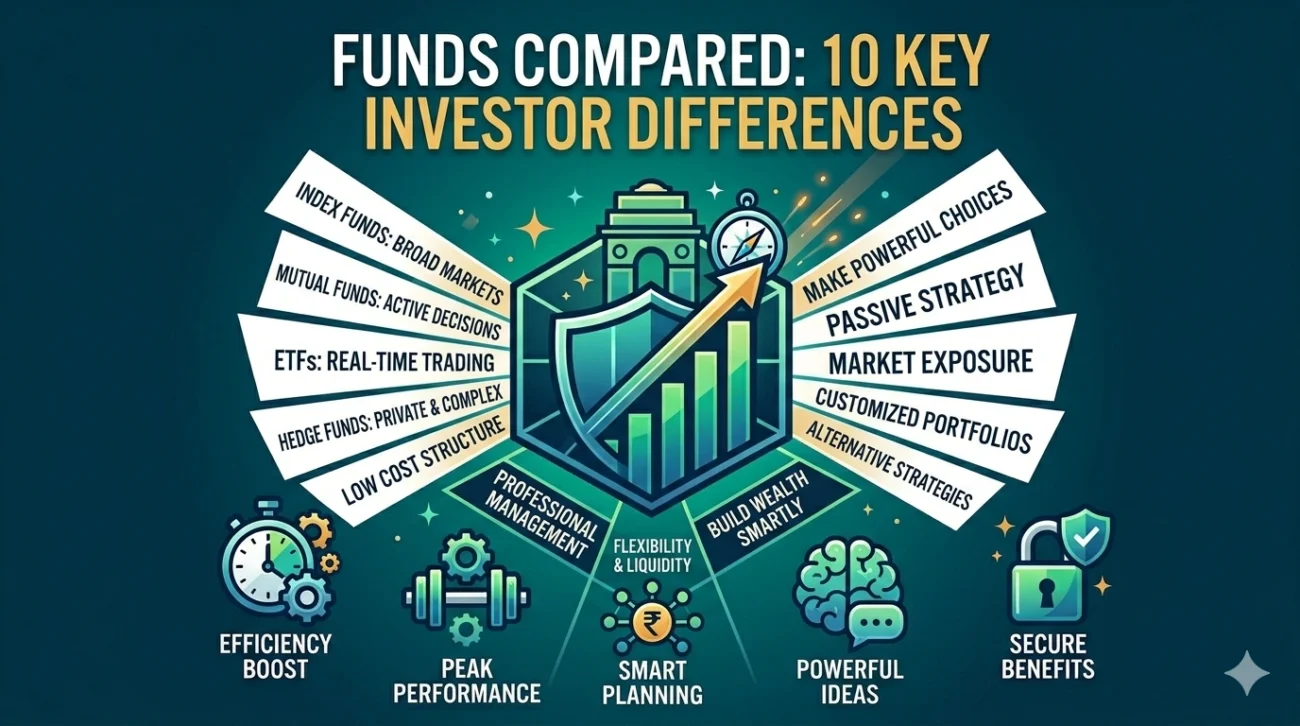
Index funds vs mutual funds vs ETFs vs hedge funds is one of the most important comparisons every investor must understand in 2026. Whether you’re a beginner or an experienced investor, choosing the right investment vehicle can significantly impact your returns, risk, and long-term wealth creation.
Index Funds vs Mutual Funds vs ETFs vs Hedge Funds: Key Differences Explained
If you’re starting your investment journey, you’ve likely come across terms like index funds, mutual funds, ETFs (exchange-traded funds), and hedge funds. While they all involve pooling money and investing in assets, they differ significantly in risk, returns, management style, fees, and accessibility.
Understanding these differences is crucial for making smart investment decisions, whether you’re a beginner or an experienced investor.
What Are Index Funds in Index Funds vs Mutual Funds vs ETFs vs Hedge Funds Comparison?
| Feature | Index Funds | Mutual Funds | ETFs | Hedge Funds |
|---|---|---|---|---|
| Management Style | Passive | Active | Passive/Active | Aggressive Active |
| Goal | Track index (e.g., Nifty 50, S&P 500) | Beat market | Track or trade market | Maximize returns |
| Risk Level | Low to Moderate | Moderate to High | Moderate | Very High |
| Fees (Expense Ratio) | Very Low | Moderate to High | Low | Very High |
| Liquidity | Low (end-of-day NAV) | Low (end-of-day NAV) | High (traded like stocks) | Low |
| Minimum Investment | Low (₹500 SIP) | Low to Medium | Price of 1 unit | Very High (lakhs/crores) |
| Transparency | High | Medium | High | Low |
| Best For | Beginners, long-term investors | Active investors | Traders + investors | HNIs & institutions |
👉 Insight: This table targets featured snippet ranking for keywords like “difference between index funds and ETFs” and “mutual funds vs hedge funds comparison”.
What Are Index Funds? Low-Cost Passive Investing Explained
Index funds are a type of mutual fund that simply tracks a market index like Nifty 50 or S&P 500. Instead of trying to beat the market, they aim to replicate its performance.
Why Index Funds Are Popular in 2026
- Extremely low expense ratios (0.1%–0.5%)
- Consistent returns aligned with market growth
- No fund manager bias
- Ideal for long-term wealth creation
Best For
- Beginners
- Passive investors
- Long-term goals like retirement
👉 index fund investing, best index funds for beginners, passive investing strategy
Mutual Funds in Index Funds vs Mutual Funds vs ETFs vs Hedge Funds Guide
Mutual funds pool money from investors and are managed by professional fund managers who actively select stocks or bonds to beat the market.
Types of Mutual Funds
- Equity mutual funds
- Debt mutual funds
- Hybrid funds
- ELSS (tax-saving funds in India)
Pros
- Professional management
- Diversification
- Suitable for SIP investments
Cons
- Higher fees (1%–2.5%)
- Performance depends on fund manager
👉 mutual fund investment India, SIP investment guide, active vs passive investing
ETFs Explained in Index Funds vs Mutual Funds vs ETFs vs Hedge Funds
ETFs combine features of both stocks and mutual funds. They track an index like index funds but are traded on stock exchanges like shares.
Key Benefits of ETFs
- Real-time buying and selling
- Lower expense ratio than mutual funds
- High liquidity
- Transparent holdings
Example
You can buy a Nifty ETF just like you buy a stock on the exchange.
Best For
- Investors who want flexibility
- Traders who prefer real-time pricing
👉 TF investing, what is ETF in stock market, ETF vs index fund India
Hedge Funds in Index Funds vs Mutual Funds vs ETFs vs Hedge Funds Comparison
Hedge funds are advanced investment vehicles that use complex strategies like:
- Short selling
- Leverage
- Derivatives
- Arbitrage
They aim to generate maximum returns regardless of market conditions.
Key Characteristics
- Only available to high-net-worth individuals (HNIs)
- High fees (2% management + 20% profit share)
- Very high risk
Why Hedge Funds Are Not for Beginners
- Complex strategies
- Lack of transparency
- High capital requirement
👉 hedge fund meaning, hedge fund vs mutual fund, high risk investments
Index Funds vs Mutual Funds vs ETFs vs Hedge Funds: Which Is Best in 2026?
Both are passive, low-cost options — but the key difference lies in how they are traded.
- Index funds → Bought at end-of-day NAV
- ETFs → Traded throughout the day
Which Should You Choose?
- Choose index funds for simplicity and SIP investing
- Choose ETFs for flexibility and trading opportunities
Mutual Funds vs Index Funds: Active vs Passive Debate
This is one of the most searched investment comparisons globally.
Key Insight
- Most active mutual funds fail to beat index funds in the long run
- Index funds win due to lower cost and consistency
👉 Target: mutual funds vs index funds returns comparison
Which Investment Option Is Best for You in 2026?
For Beginners
👉 Index Funds + SIP
For Moderate Investors
👉 Mix of Mutual Funds + ETFs
For Advanced Investors
👉 Direct stocks + ETFs
For Ultra-Rich Investors
👉 Hedge Funds
Smart Investment Strategy: Combining All 4 for Maximum Returns
A balanced portfolio could look like:
- 50% Index Funds
- 30% Mutual Funds
- 15% ETFs
- 5% Alternative investments
This ensures diversification, growth, and flexibility.
Common Mistakes Investors Make While Choosing Funds
- Choosing high-return funds without checking risk
- Ignoring expense ratios
- Over-diversification
- Following trends blindly
- Not aligning investments with financial goals
Conclusion: Choose Smart, Not Complex
You don’t need complicated strategies to build wealth. For most investors, index funds and mutual funds are more than enough to achieve financial freedom.
ETFs add flexibility, while hedge funds are suitable only for advanced investors with high capital.
👉 The real secret: Start early, stay consistent, and keep costs low.
FAQs on Index Funds vs Mutual Funds vs ETFs vs Hedge Funds
Q1. What is the main difference between index funds and ETFs?
Index funds are bought at NAV, while ETFs are traded on stock exchanges like stocks.
Q2. Are mutual funds better than index funds?
Not always. Index funds often outperform mutual funds due to lower fees.
Q3. Are ETFs safe for beginners?
Yes, but they require a demat account and basic market knowledge.
Q4. Why are hedge funds risky?
They use leverage and complex strategies, which can lead to high losses.
Q5. Which investment is best for long-term wealth?
Index funds and mutual funds are the best for long-term wealth creation.
About The Author

